Storage is becoming a standard part of industrial energy strategy. But a BESS only delivers its value when measurement and control work together, across equipment from different vendors. Here is how that looks in a real plastics plant.
Why storage is moving into the factory
For years, battery storage was a utility story. That has changed, and industrial sites are now part of the picture.
Europe installed 27.1 GWh of new battery capacity in 2025, the 12th consecutive record year for storage deployment, according to SolarPower Europe. GreenPowerMonitor, citing DNV’s Energy Transition Outlook, describes storage as a key enabler of grid stability and flexibility as more variable renewables join the system, and points to falling lithium-ion costs as a supporting trend.
For an industrial site, the role goes beyond backup. A battery can give instantaneous support during an outage, keeping production running until generators synchronise or the grid recovers. For a plant with continuous thermal processes, that alone can justify the conversation.
The economics are broadening too. CBRE’s market update lists several angles:
-
- Batteries let industrial sites earn from price swings while hedging over the long term against gas-set prices.
-
- Cutting demand at peak hours with a battery can lower an industrial site’s grid fees.
-
- About €600 million in subsidy programs is available for batteries at commercial and industrial sites across eastern and southern Europe, and hosting an on-site battery lets a site take part in deals that secure those subsidies. Eligibility depends on the country and the specific programme.
-
- Most utility-scale batteries are stuck in multi-year interconnection queues, so a project on an existing industrial connection has an easier and quicker path.
-
- Grid scarcity is putting some industrial connections in France at risk. Where grid capacity is tight, on-site storage becomes a way to work within the connection you already have.
The opportunity is real. But every one of these benefits depends on the same thing: the battery has to behave correctly, minute by minute, for that specific site.
The catch: a battery is only as smart as its data
A battery is a storage asset. Its value depends on when it charges and when it discharges, and that depends on what the site is doing at that moment: how much the PV plant is producing, what the production lines are drawing, and what is crossing the connection point.
Even sizing needs measured data. Peak-shaving capacity is calculated from the gap between peak power and the target threshold, multiplied by the duration of the peak. Without measured peaks, that formula is a guess.
And on real sites, the equipment rarely comes from one vendor.
The case study: a plastics processing plant, three vendors, one connection point
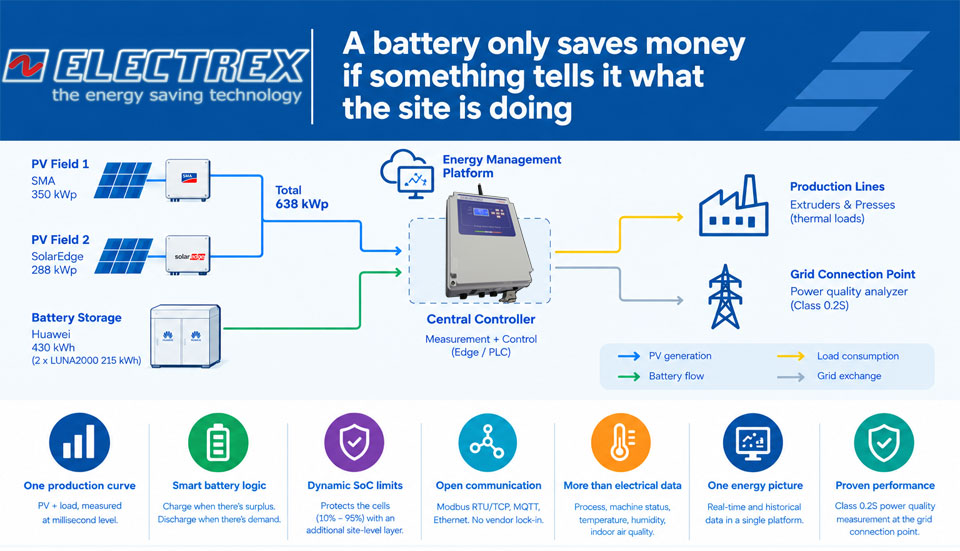
The site runs extruders and presses, which are heavy thermal loads. On the generation side it has two PV fields: 350 kWp of SMA and 288 kWp of SolarEdge, 638 kWp in total. Storage is a Huawei battery of 430 kWh, made of two LUNA2000 cabinets of 215 kWh each.
Three vendors means three systems that were never designed to coordinate with each other. Without a common layer, nobody at the plant sees one energy balance, and nothing decides, at the point where the site meets the grid, what the battery should do.
Direction: one point of control, working on measured data
The approach is to place a central controller at the connection point and let it act on three things.
1. A single production curve. The controller reads both inverter fields over Modbus TCP and adds them into one PV curve. It compares that curve with the load of the production lines. Load is sampled at millisecond level, so the site knows at any moment whether it has a surplus or a deficit.
2. Battery logic driven by that balance. When PV exceeds consumption, the surplus is stored in the two battery cabinets instead of being exported to the grid. When the plant draws more than PV can supply, the battery discharges and reduces the peaks taken from the grid.
3. State-of-charge limits set dynamically. The controller monitors state of charge continuously and sets the operating window (for example between 10% and 95%) to protect the LFP cells. The battery’s own management system protects the cells at the hardware level, and the site-level limits are an additional layer on top.
Where Electrex fits: one solution, not a collection of parts
This is the part where the choice of architecture matters. A BESS project usually ends up with separate boxes for measuring, separate boxes for controlling, separate software for visualising, and a lot of integration work in between. Each interface is another place where something can go wrong.
Electrex approaches it differently, as one solution built from three layers that were designed to work together.
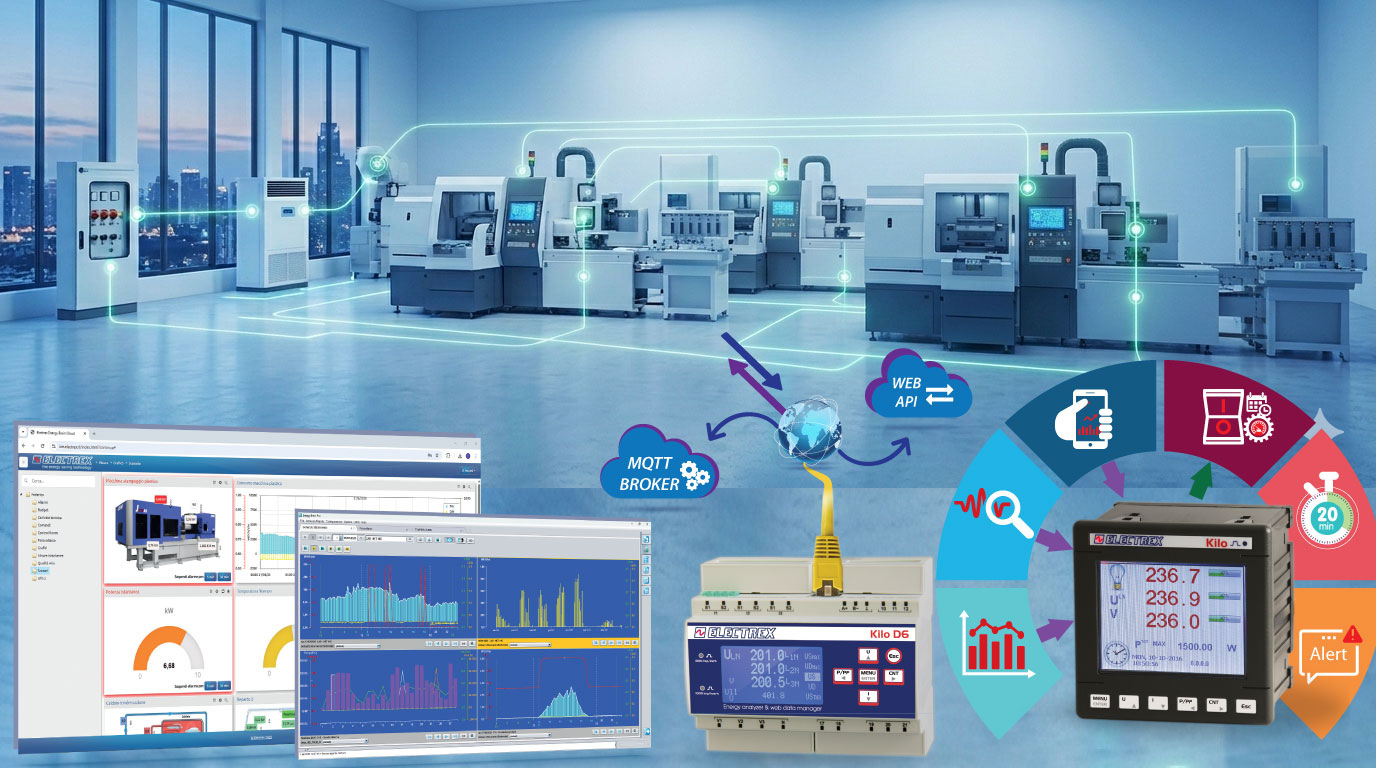
Multifunction devices: measurement and control in the same unit. Our analyzers and controllers measure the electrical quantities and also run the control logic on the same device, through built-in relays and I/O and an integrated PLC programmable in Ladder. The device that sees the load is also the device that decides. That means fewer components in the cabinet, fewer integration points, and control decisions taken where the measurement happens, on data sampled at millisecond level.
Open communication, so the battery is never locked to one brand. The devices speak the protocols that inverters and storage systems already use, including Modbus RTU and TCP, MQTT and Ethernet. In this plant, that is what allows the SMA inverters, the SolarEdge inverters and the Huawei battery to be read and commanded through one centralized layer.
Sensors for the conditions around the electrical data. Energy behaviour depends on more than kilowatts. Our solutions also bring in process data, such as machine status, and environmental data such as temperature, humidity and indoor air quality. For a plant like this one, that means battery decisions can be read against what the production lines are actually doing.
Software that turns the data into something people can use. The measurements feed an energy management platform that aggregates the flows, shows the energy balance in real time, and keeps the history. The plant sees the PV curve, the load of the production lines and the battery behaviour on the same screens, instead of in three vendors’ apps.
A record of what actually crossed the connection point. A Class 0.2S power quality analyzer at the connection point logs imports, exports and power quality events continuously. That is the evidence that the battery is doing its job. It also matters because grid connection codes for storage exist to make sure a BESS does not harm power quality, and that can only be demonstrated with measurements.
What the site gets
-
- More of its own PV energy used on site. Self-produced energy covers the thermal processing cycles that draw the most power.
-
- Equipment from different vendors working together. One centralized Modbus TCP layer instead of three separate systems.
-
- Peak demand attenuated by fast battery response, which reduces exposure to peak-related charges.
-
- One energy picture across generation, storage, loads and the grid connection.
If you are planning storage on an existing site
Start with the measurement. Before choosing battery size or vendor, know your real load profile and the peaks that drive your costs. The battery can then be sized against data, and the control layer has something to work from on day one.
If you are an integrator, OEM or panel builder with a PV-plus-storage project in the pipeline, get in touch and I will walk you through how this architecture would map onto your project.
Sources: GreenPowerMonitor, “BESS Europe: storage industry growth and application” (citing SolarPower Europe and DNV); CBRE, “European Power Markets and Battery Storage Update”; AnengJi Energy, grid-connected battery storage guide.
Contact me to schedule a call! I will be glad to answer any questions you may have.

About us

Since 1993 Electrex designs, develops, manufactures and markets, Made in Italy, instruments and software for energy management and control.
The Electrex solutions are used in the Energy Efficiency and Energy Automation applications, for the industrial, commercial, public, civil, and renewable energy sectors allowing a rapid return on investment.
The solutions provided up to now allow the management of over 530,000 measuring points and more than 960,000 points are controlled via Energy Automation applications.
Electrex, one of the first companies to operate in these sectors, has acquired over the years a considerable experience and competence that few other companies can claim to have. With over 40% of the staff dedicated to R & D, we demonstrate our strong commitment to innovation and continuous improvement in order to anticipate the needs of our customers.